


The Bad River Band of Lake Superior Chippewa has denied Enbridge Energy a permit to use sandbags to deal with an imminent rupture on Line 5 running through the reservation
June 8, 2023
Barbara With
At the June 7, 2023 meeting of the Bad River Band of Lake Superior Chippewa Tribal Council, Mashkiiziibii Natural Resources Department (MNRD) Director Naomi Tillison recommended the Band deny a permit to Enbridge for a plan to sandbag the river as a temporary solution to the Band’s urgent call to shut down Line 5.
“Considering the comments, considering the conversations and communications we’ve had with Enbridge, and then our own review, I’m here tonight to recommend that the Tribal Council deny this project under the Anti-Degradation Policy of the Tribe’s Water Quality Standards.” The Council voted unanimously to deny the permit.
On May 11, Bad River filed an emergency petition to District Court Judge William Conley to shut down the line because of the imminent and catastrophic danger present as the river continues to erode the bank near the pipeline. At the May 18 hearing, when the river was only 11 feet from the pipeline, Judge Conley admitted he not only had the power to shut it down, but he also stated that he believed it was only a matter of time before the line would have to be shut down. Instead of ruling to shut down the line, he announced he would be considering his options over the next few weeks. At the time of the hearing, he also agreed to provide a threshold – a specific distance between the pipeline and the river – that would trigger shut down order to stop the oil flow and purge the pipe. As of today, he has yet to deliver his written opinion.
Today the Pipeline Hazardous Materials Safety Administration (PHMSA) inspected the meander.
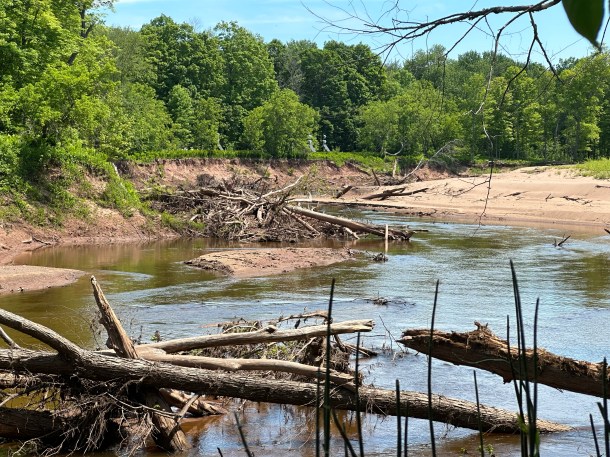
As of June 8, people on the ground are reporting the ground is sandy and shifting. The drone shots also show continuing erosion all along the line. The remote terrain makes the area inaccessible by land. Enbridge was suggesting airlifting sand bags as a short-term solution to a long-term problem.
At the June 7 Tribal Council meeting, Tillison presented the procedural history between Bad River and Enbridge, including documentation of their communications and meetings during the application process.
On May 25, Tillison recommended tabling the permit due to lack of response from Enbridge to a request for additional information.
On Monday, June 5, Tillison met with Enbridge to try to better understand some of the details that weren’t clear in the application materials.
Tillison also shared a communication from the Army Corps of Engineers (ACE) that was sent to both the Bad River Band and Enbridge, clarifying some claims that Enbridge had made:
“The Corps has not completed analysis whether the proposed project is sound or that the placement of sandbags are appropriate to stabilize the vacant meander.”
ACE will also have to determine whether or not the material is suitable, and, according to ACE, “the Corps has not yet received information indicating that the placement of sandbags is suitable material to withstand normal high flows at this location.”
MNRD concluded that Enbridge did not demonstrate that the project meets the Band’s anti-degradation requirements and that Enbridge has not adequately provided full responses pertaining to critical information needed regarding key concerns about the project. There were also concerns regarding missing information.
The Band has communicated to Enbridge the need to purge and shut down the pipeline during the use of helicopters, based on lessons learned in 2019 after Enbridge dropped a 7,800 pound load of polymats on the reservation that sunk the ground beneath almost three feet. However, Enbridge has no plans to purge and shut down the pipeline during the use of helicopters. They proposed to carry loads within 11 feet of pipeline corridor directly above the river bank to install the sandbags. Bad River’s policies require them to stay more than 60 feet away from the pipeline, which they won’t be able to do with their proposal presented at Monday’s meeting. Still, Enbridge doesn’t feel a need to shut down and purge the line, even though there is that potential for a rupture if they were to have a similar accident and the sandbags land on the pipeline.
Enbridge responded by saying they have a “manual release mechanism” to prevent accidental releases and believe another release of sandbags would disperse without compressing the surface, thus avoiding a rupture.
“We do not share Enbridge’s unsupported confidence,” said Tillison.
The Band also has concerns about contaminants in the sand and lack of a restoration plan. Enbridge has only provided a small amount of information about how they would remove the sandbags and restore the site.
According to Band River’s anti-degradation policies, the impacts need to be short term and temporary, and Enbridge has not provided the assurance that will happen. Enbridge also stated that they do not feel a surety bond is needed because they claim they are removing the sandbags on to their own property.
Furthermore, Enbridge has not met its burden to evaluate alternatives and demonstrate the necessity of the project, which is also a requirement under the Band’s policies.
Residents in the area are nervously watching the weather forecast. Those living in and around the Bad River watershed know the unpredictability of weather and the power of the water. Even dry weather does not render the situation at the meander any less urgent. Storms have rapidly developed in the past several years and done significant damage.

 Wisconsin Citizens Media Cooperative
Leave a comment